
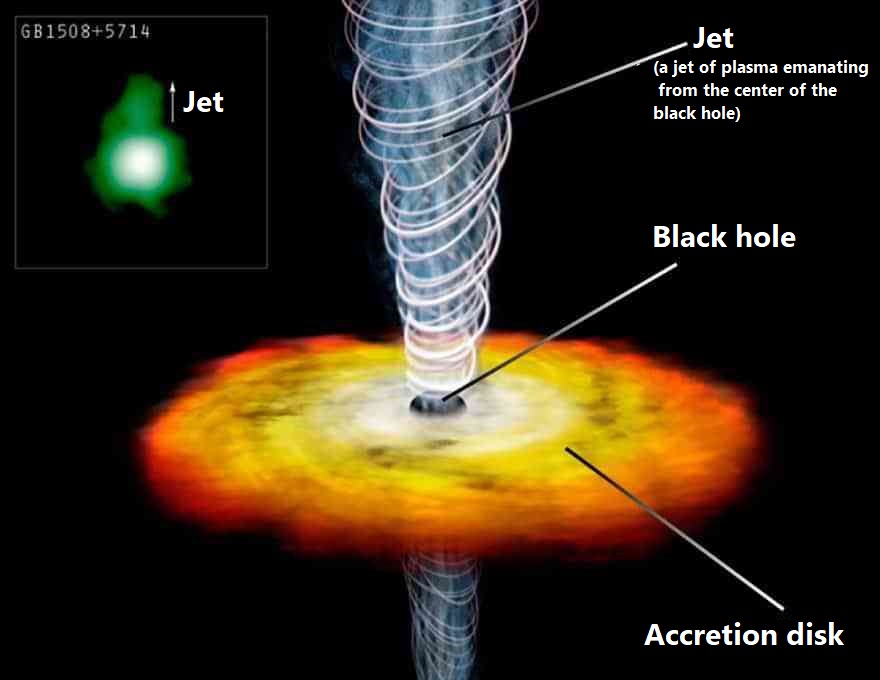
Although this phenomenon has not been studied enough, but, according to preliminary data, the quasar is a huge black hole. Its matter accelerates its movement when the hole funnel tightens matter, which leads to the heating of these particles, their friction against each other and the endless movement of the total mass of matter. The speed of the quasar molecules becomes more and more with each second, and the temperature is higher. The strong friction of the particles causes the release of a huge amount of light and other types of radiation, such as x-rays. Every year, black holes can absorb a mass equal to one of our Sun. As soon as the mass sucked into the deadly funnel is absorbed, the released energy will be radiated in two directions: along the southern and Northern poles of the quasar. Astronomers call this unusual phenomenon “space plane”. Recent observations of astronomers show that most of these celestial objects are in the center of elliptical galaxies.
Quasars are often compared to beacons of the Universe. They can be seen from the farthest distances, thanks to them, they study its evolution and structure. With the help of “heavenly beacon” study the distribution of any substance on the beam of vision. Namely, the strongest spectral absorption lines of hydrogen are transformed into lines along the red shift of absorption.
Versions of scientists about quasars
There is another scheme. Quasar, according to some scientists, is an emerging young galaxy. The evolution of galaxies is little studied, as humanity is much younger than they are. Perhaps quasars are an early state of galaxy formation. It can be assumed that the release of their energy comes from the youngest nuclei of active new galaxies. Other astronomers consider quasars to be the points of space where the new matter of the Universe originates. Their hypothesis proves the exact opposite of a black hole. Humanity will need a long time to study the stigmata of quasars.
Light jets in quasars
Scientists think that the point flashes are signals from galactic nuclei outshining the galaxy. Quasars can only be found in galaxies that have supermassive black holes. Although light is not able to escape from this place, some particles make their way near the edges. While dust and gas are sucked into the hole, other particles move away almost at the speed of light.
Most of the quasars in the Universe were discovered billions of light-years away. Therefore, studying such objects, we seem to return to the past. Many of 2000 found quasars existed still in the early galactic life. Quasars are capable of generating energy up to a trillion electron volts. This is more than the amount of light of all stars in the galaxy (brighter than the glow of the milky way 10^100000 times).
 Quasars